
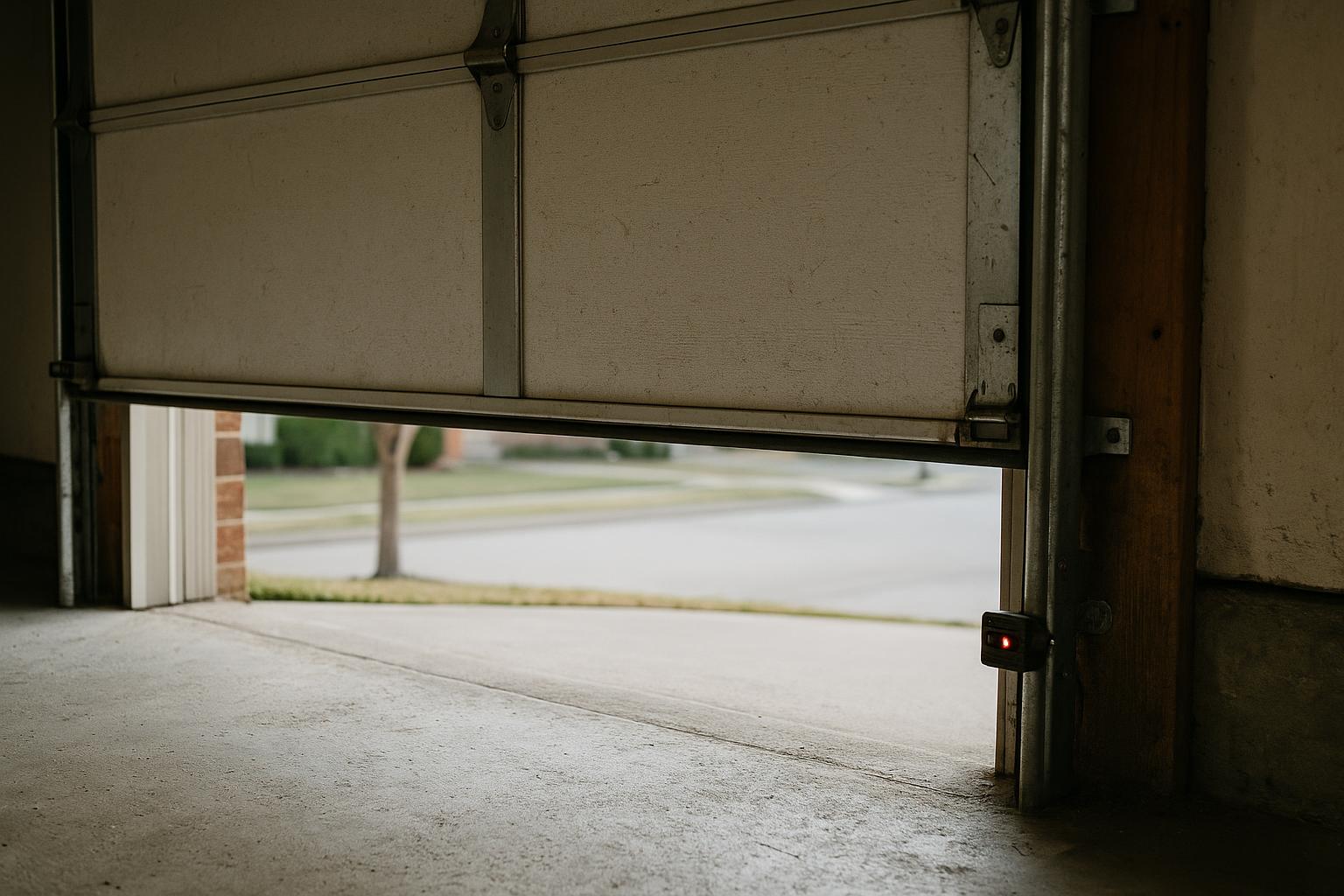
That Frustrating Moment When Your Garage Door Won't Stay Closed
You press the button on your garage door remote, watch the door glide downward, and then — just inches from the floor — it stops and reverses back up. You try again. Same thing. Maybe it works on the third try, maybe it doesn't. Either way, you're left standing in your driveway in Raymore wondering what just happened.
This is one of the most common garage door complaints we hear from homeowners, and the good news is that it usually has a straightforward explanation. The bad news? Ignoring it can lead to bigger problems down the road, including a door that stops working entirely or a security risk for your home.
Let's walk through the most likely reasons your garage door reverses before reaching the floor and what you can do about each one.
1. Misaligned Safety Sensors
This is the number one cause of a garage door that reverses before closing completely. Every garage door opener manufactured after 1993 is required to have photo-eye safety sensors mounted near the bottom of the door tracks on each side. These sensors send an invisible beam across the opening, and if anything breaks that beam — a child, a pet, a trash can — the door automatically reverses to prevent injury.
The problem is that these sensors can become misaligned over time. A bump from a bicycle, vibration from daily use, or even temperature changes can shift them just enough that the beam no longer connects properly. When the opener thinks the beam is broken, it reverses the door as a safety precaution.
What to Check
- Look at the LED lights on each sensor. Most models show a steady green light on one sensor and a steady amber or green light on the other when properly aligned. A blinking light usually means misalignment.
- Make sure nothing is blocking the path between the two sensors, including cobwebs, dirt, or debris.
- Gently adjust the sensors until both lights are steady, then tighten the mounting brackets.
If you've cleaned and adjusted the sensors and the problem persists, the wiring or the sensors themselves may need replacement.
2. The Close-Limit Switch Needs Adjusting
Your garage door opener has a setting called the close-limit switch (sometimes called the down-limit or travel-limit adjustment). This tells the opener exactly how far the door needs to travel before it's considered fully closed. If this setting is off — even by a small amount — the opener may think the door has hit an obstruction when it's actually just reaching the floor.
When the opener senses resistance that it interprets as an obstruction, it activates the auto-reverse feature and sends the door back up.
What to Check
- Consult your opener's manual for instructions on adjusting the close-limit setting. On most models, there's a small dial or screw on the back or side of the motor unit.
- Make small adjustments — usually a quarter turn at a time — and test the door after each change.
- If you're not comfortable making this adjustment yourself, this is a quick fix for a trained technician.
3. Worn or Damaged Rollers and Tracks
Garage door rollers guide the door along the metal tracks on either side of the opening. Over time, rollers can wear down, crack, or become coated in grime. Damaged tracks can develop bends, dents, or rust spots. Any of these issues can create friction or resistance as the door travels, and the opener may interpret that resistance as an obstruction and reverse.
Homeowners in the Raymore area deal with significant temperature swings between summer and winter, which can cause metal tracks to expand and contract. This seasonal stress makes regular inspection even more important.
What to Check
- Visually inspect the rollers for cracks, chips, or flat spots.
- Look along the tracks for dents, bends, or buildup of dirt and debris.
- Listen for grinding, scraping, or squealing sounds when the door moves — these are signs of roller or track problems.
Replacing worn nylon or steel rollers is a relatively affordable maintenance task that can dramatically improve your door's performance.
4. Broken or Weakening Springs
Your garage door springs do the heavy lifting — literally. They counterbalance the weight of the door so the opener doesn't have to work as hard. When springs begin to weaken or lose tension, the door becomes heavier for the opener to manage. The opener may struggle to control the door's descent, sense excessive force, and trigger a reversal.
A fully broken spring is usually obvious because the door will barely move at all or will feel extremely heavy if you try to lift it manually. But a spring that's losing tension can cause intermittent reversing problems that are harder to diagnose.
Important safety note: Garage door springs are under extreme tension and can cause serious injury if handled improperly. Spring replacement is not a DIY job. If you suspect a spring issue, contact a professional.
5. Problems with the Opener's Force Setting
In addition to the travel-limit setting, your opener also has a force setting that controls how much resistance the motor will push through before reversing. If this is set too low, the opener may reverse at the slightest resistance — even the normal friction of the weatherstripping at the bottom of the door meeting the garage floor.
What to Check
- Like the limit switch, the force adjustment is typically a small dial on the opener unit.
- Increase the downward force setting slightly and test the door.
- Be careful not to set the force too high, as this can override the safety reverse feature and create a hazard.
6. Damaged Weatherstripping or an Uneven Floor
Sometimes the issue isn't with the door or the opener at all. If the rubber weatherstripping along the bottom of your door has become stiff, warped, or is peeling away, it can catch on the garage floor and create resistance. Similarly, if your garage floor is uneven or has settled over time, the door may hit the high spot and reverse.
Replacing bottom weatherstripping is an inexpensive fix that also improves your garage's insulation and keeps out pests, water, and debris — especially useful during Missouri's unpredictable storm seasons.
When to Call a Professional
Some of these issues are simple enough for a handy homeowner to address. Cleaning sensors, adjusting limit switches, and replacing weatherstripping are all reasonable DIY tasks. However, there are situations where professional help is the smart choice:
- You've tried the basic troubleshooting steps and the door still reverses.
- You suspect a spring issue or hear unusual sounds from the spring assembly.
- The door behaves erratically — sometimes closing, sometimes not.
- You notice frayed cables, loose hardware, or visible damage to major components.
- You're simply not comfortable working on the door yourself.
At Raymore Garage Door Solutions, we diagnose reversing issues quickly because we see them regularly. Most of the time, we can resolve the problem in a single visit and have your door operating reliably again the same day.
Don't Ignore a Reversing Garage Door
It might seem like a minor annoyance, but a garage door that won't close properly is a security vulnerability and a sign that something in the system needs attention. Left unaddressed, small problems can escalate into expensive repairs or a complete door failure at the worst possible time.
If your garage door has been giving you trouble in Raymore or the surrounding communities like Belton, Lee's Summit, or Pleasant Hill, give us a call. We'll figure out what's going on and get it fixed — no guesswork, no runaround.