
Rule of thumb: a garage door that won't open is usually a cheap, simple fix—dead batteries, a tripped breaker, or dirty sensors—unless the door won't move even when you pull the manual release, in which case you're almost always looking at a broken spring or cable. The exceptions matter: a door that opens partway and reverses is a sensor or limit problem, not a power problem, and a door that's merely heavy or slow (not stuck) usually means aging springs rather than a dead opener. Knowing which symptom you have narrows the search before you ever touch a tool.
Start With What the Door Is Actually Doing
Before you check anything, stand in the garage and press the button. What happens tells you where to look first.
- Nothing at all — no light, no hum, no click. This points to power.
- The opener hums or the motor runs, but the door doesn't move. This points to a disconnected trolley, a stripped internal gear, or a spring that's too broken for the motor to lift the door's weight.
- The door opens a few inches, then stops or reverses. This points to the safety sensors or a limit setting, not the motor.
- The door moves, but slowly, unevenly, or with grinding. This points to the track, rollers, or aging springs.
- The door won't budge even when you pull the red manual release cord. This is almost always a broken spring or a snapped cable — the door is physically too heavy to lift by hand.
The Checklist, In the Order a Technician Runs It
1. Power to the Opener
This sounds obvious, but it's the first thing checked because it's the fastest to rule out. Garage opener outlets are often on a GFCI circuit, and GFCIs trip easily in humid Missouri summers or when condensation gets into the outlet box during winter freeze-thaw cycles. Check the outlet itself, check the breaker panel, and confirm the opener's indicator light is on. If the light is off and resetting the GFCI or breaker doesn't bring it back, the opener's circuit board or power supply may have failed.
2. Remote and Wall Control
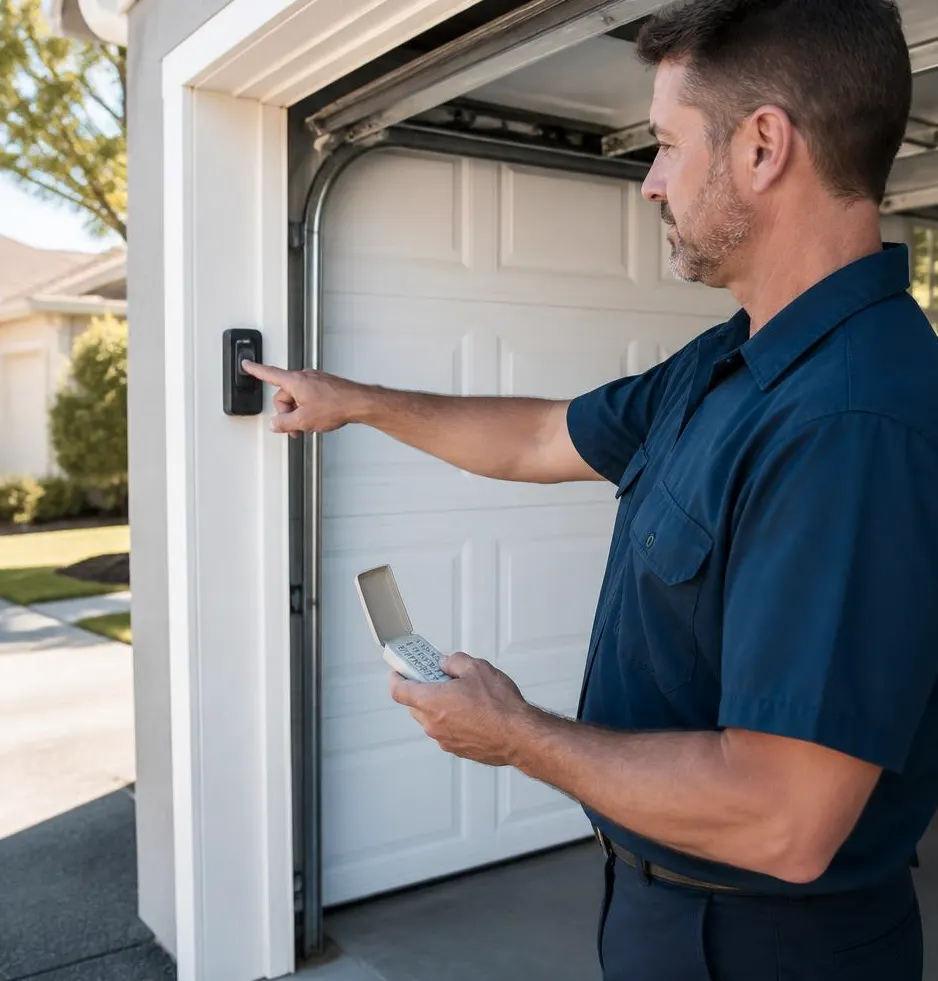
Next is the simplest possible failure: dead batteries in the remote, a stuck wall button, or a wall control that's lost its connection to the opener. Swap the battery, try a second remote or the wall button directly, and see if the behavior changes. If the wall button works but the remote doesn't, the fix is a battery or a resync, not a service call.
3. Safety Sensors (Photo Eyes)
These are the small sensors mounted a few inches off the floor on each side of the track. If they're dirty, misaligned, or something is blocking the beam between them, the opener will refuse to close the door and may also refuse to open it depending on the model. In this part of Missouri, road salt tracked in on tires and winter condensation both leave a grimy film on the sensor lenses, and a bump from a stored bike or holiday decorations is enough to knock them out of alignment. Wipe both lenses, make sure both LEDs are solid (not blinking), and check that nothing sits in the beam's path.
4. Manual Release or Vacation Lock
If the red release cord was pulled recently — during a power outage, for example — the door is disconnected from the opener and won't respond to any button. Pulling it back toward the track and re-engaging the trolley is the fix. Some openers and some manually locked doors also have a slide bolt or vacation lock engaged on the track itself; it has to be retracted before the opener can do anything.
5. Track, Rollers, and Obstructions
A technician will run a hand along the track looking for a bent section, built-up ice, or debris. Garages that aren't heated see ice form on the bottom track in winter, and that ice can keep the door from traveling even when everything else is fine. Rollers that are worn, rusted, or missing a bearing will also bind in the track and stall the door partway.
6. Springs
This is where things get serious. The springs — torsion springs mounted on a bar above the door, or extension springs along the upper track — carry almost all of the door's weight. When one breaks, the opener motor simply isn't strong enough to lift the door on its own, which is why you'll often hear the motor straining or humming with no movement. A visual check is usually enough to confirm: a torsion spring with a visible gap, or an extension spring hanging loose, has failed. This is not a DIY repair; spring tension can cause serious injury, and it requires the right replacement spring for the door's weight and size.
7. Cables
The cables run alongside the springs and guide the door's movement along the track. A frayed or snapped cable will often let one side of the door hang lower than the other, or cause the door to bind and jam partway through its travel. Like springs, these are under tension and are a professional repair, not a weekend project.
8. Opener Gears and Internal Motor
If everything above checks out and the door still won't move, the last stop is inside the opener housing itself. Older chain and belt-drive openers commonly strip an internal plastic gear after years of use — you'll hear the motor running at full speed with no corresponding door movement. This points to either a gear replacement or, if the opener is old enough, a full opener replacement.
When to Call Raymore Garage Door Solutions
If you've worked through the list above and you're still stuck — especially if the door won't move by hand, a spring looks broken, or a cable is hanging loose — it's time to call. Our Garage Door Repair service covers everything from sensor realignment and track adjustments to cable and spring issues, and our Spring Replacement service uses properly matched springs sized for your door's weight, not a generic swap. If your door fails at an inconvenient moment — storm season, a holiday, late at night — our Emergency Garage Door Service is built for exactly that.
If your garage door in Raymore, MO won't open and you've run out of easy fixes, give Raymore Garage Door Solutions a call. We'll find the cause fast and get your door back on track the same day.